Minnie Castevet’s chocolate mousse
Rosemary's BabyMinnie Castevet’s chocolate mousse is a gift that changes the meaning of Rosemary and Guy Woodhouse’s dinner. Presented as an ordinary dessert after Rosemary has questioned its taste and been urged to finish it, the mousse becomes inseparable from her dizziness and from a dream in which Minnie says that eating it prevents Rosemary from seeing or hearing what is happening. The book leaves the connection to be read through this sequence: a neighbor’s courtesy, a husband’s insistence, a sudden alteration in Rosemary’s condition, and a dream that supplies a chilling explanation for her impaired awareness.
Arrival at Dinner
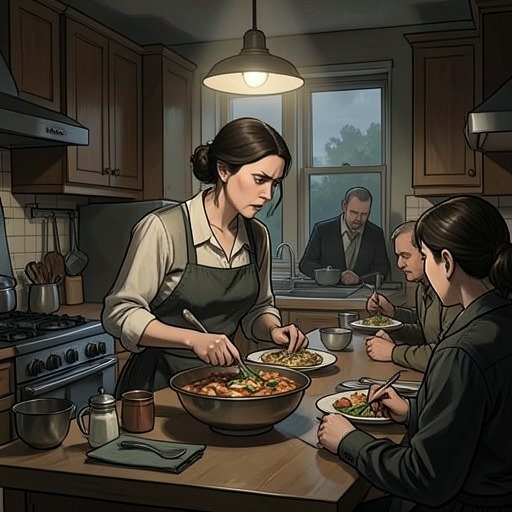
Rosemary and Guy are halfway through their swordfish when Minnie appears at the door. Rosemary listens as Guy speaks with her and hopes Minnie will not come in; the door is closed, chained, and bolted. Guy then enters the dining room carrying two white custard cups, one for each of them, and presents the unexpected dessert as a small surprise. The arrangement allows Minnie’s gift to enter the meal without her entering the apartment. What Rosemary had briefly feared as an unwelcome visit becomes a more intimate intrusion: the neighbors’ presence is conveyed through food, delivered by Guy and set beside the couple’s wineglasses.
The dessert also echoes Rosemary’s own plans. She says she had intended to make mousse, which initially makes the gift seem thoughtful and timely. She laughs, and Guy treats its arrival as a playful instance of ESP. For a moment, the cups belong to the ordinary rhythm of a dinner between spouses: surprise, amusement, and a shared treat. That ease matters because the episode’s threat is not announced by an obviously alarming object. The mousse enters under the cover of neighborliness and domestic familiarity.
A Gift That Becomes an Obligation
The cups have peaked swirls of chocolate; Guy’s is topped with chopped nuts, while Rosemary’s has half a walnut. Rosemary calls the gesture sweet and says they should not make fun of Minnie. Yet the taste unsettles her: after two spoonfuls, she detects a chalky undertaste and puts down her spoon. Guy says he cannot detect it and asks her to finish. The difference between their reactions becomes more consequential than the dessert’s appearance. Rosemary reports a specific objection, while Guy treats that objection as something she should set aside.
When Rosemary offers Guy her portion, he links eating the mousse to the silver charm Minnie gave her. In his view, accepting a gift and then refusing to use it is another form of unkindness. The comparison turns Rosemary’s private judgment about the food into a question of politeness toward Minnie. Rosemary picks up her spoon because she does not want the disagreement to become a scene, and she eats another full spoonful. Her cheerful assurance that the mousse has no undertaste contrasts with the hesitation that preceded it. The change is not evidence that her perception has altered; it is a performance of agreement after Guy has framed refusal as discourtesy.
Dizziness and the Dream
Later, while Rosemary scrapes the uneaten mousse from her napkin into the kitchen sink, the first wave of dizziness catches her. She pauses, then continues with the dishes. When she tells Guy she is dizzy, he attributes it to alcohol and perhaps having eaten too little. He supports her toward the bedroom and carries her when her legs buckle. Rosemary closes her eyes and experiences the bed as gently tilting; Guy tells her that sleep is what she needs. The sequence places her physical disorientation immediately after the meal, but Guy supplies a mundane explanation rather than connecting it to the dessert.
Rosemary’s ensuing dream gives the mousse a more disturbing role. In the dream’s ballroom, Minnie tells Guy that, as long as Rosemary ate the mouse, Rosemary cannot see or hear and is like someone dead. The dream joins the dessert to the singing and the gathering that Rosemary perceives around the bed, making food the explanation within the dream for why those present believe their activity is concealed from her. This is a revelation about the scene as Rosemary dreams it, not an independently verified account of what the mousse contains. Its force comes from the collision between the dream’s explanation and the earlier events: Rosemary’s reluctance, Guy’s insistence, her dizziness, and his decision that she should sleep.
Narrative Significance
The mousse’s importance lies in the gap between its social meaning and its possible function. As a dessert, it is a neighbor’s kindness; as a contested gift, it tests Rosemary’s ability to refuse; in the dream, it becomes the means by which she is kept unaware. The object does not need to change in appearance for its role to change. Its ordinary presentation makes the later association more unsettling, while the couple’s different responses to its taste expose an imbalance in how Rosemary’s perceptions are treated.
The episode also makes the domestic setting part of the threat. The dessert reaches Rosemary through a chain of familiar actions: Minnie brings it, Guy accepts it, and the spouses eat at their own table. Nothing in that sequence initially distinguishes hospitality from danger. Only after Rosemary becomes dizzy does the dream recast the meal as part of a concealed ritual. By withholding a definitive explanation in the waking scene and letting the dream articulate the connection, the narrative makes the mousse a hinge between observable events and Rosemary’s frightened interpretation of them.